• The Author’s Bio

UCHENNA ONYISHI

  • When I Am With You, You Drive My Mother’s Mercedes

    April 1st, 2025

    A strange painting hangs above me, in an empty corner of the café. In it, several airplanes seem to be barreling down toward the same point in the sky. In mere moments there will be a collision. Its strangeness, its violent sun, its illusion of movement, of an inevitable progress toward doom, pulls me in. 

    I attempt to separate its details, to make out the truth from what my mind insists on seeing. But as seconds begin to feel like minutes, and minutes, like hours, what separates the painting from my reality—the frames, the wall it hangs on, the paints, the lines, the shapes—slowly fade into each other.

    There is no painting; there is no wall; and no café. Only fighter jets, bombers, cargo planes, passenger planes, and Babylonian buildings. 

    I can see them all, at my eye’s level. 

    I am on a skyscraper with no exterior walls, a tower made entirely of stairwells with no landings to connect them. I can see hell descending from the heavens, the children of men running from themselves, and into themselves, angels without wings, and sinners soaring.

    I rest my hand on my chest, for a sign of life. I look for physical details—scars, birthmarks, unhealed wounds—on my body, for a tangible proof of my identity. And as I am searching my body, I find myself inside one of the doomed airplanes, and everyone around me is panicking. 

    Through the open windows, I see a young woman that looks too much like me, leaping from one flight of stairs to another below it. I call out for her but she continues. Then my name, and she turns her head and our eyes meet, but she turns away and keeps jumping from one staircase to the next.

    On the staircase, I scramble after her, desperate to catch up.

    A deafening bang splits the air, and I turn toward the sound. The sky erupts in a fiery red and yellow that spreads outward toward the towers and the chaos intensifies. Then, through the chaos, I see them—burning bodies, silhouettes of people engulfed in fire, falling from the sky like space debris.

    When I turn back toward her direction, she is gone. I bolt down the stairs, leaping from one flight to the next, twisting left and right, squeezing through the mad crowd, searching for her amidst the blur of frightened faces.

    I see things like this all the time—the end of the world—and every time, there is nothing I can do to prevent it. Nothing I can do to save her. In the end, I am all alone. Perhaps she survives, but if she does, she is alone too.
    Your gaze is a patient wind; it travels through my forest of defenses and bends me to its wishes. And I am happy when it does—you have never led me astray. I trust you with my life. Sometimes, more than I trust myself with it. And I understand that this is a regretful way to feel about oneself, and a burdensome truth for you to bear. Nonetheless, I am afraid I will become a timberland of felled trees if I lose what is left of me.

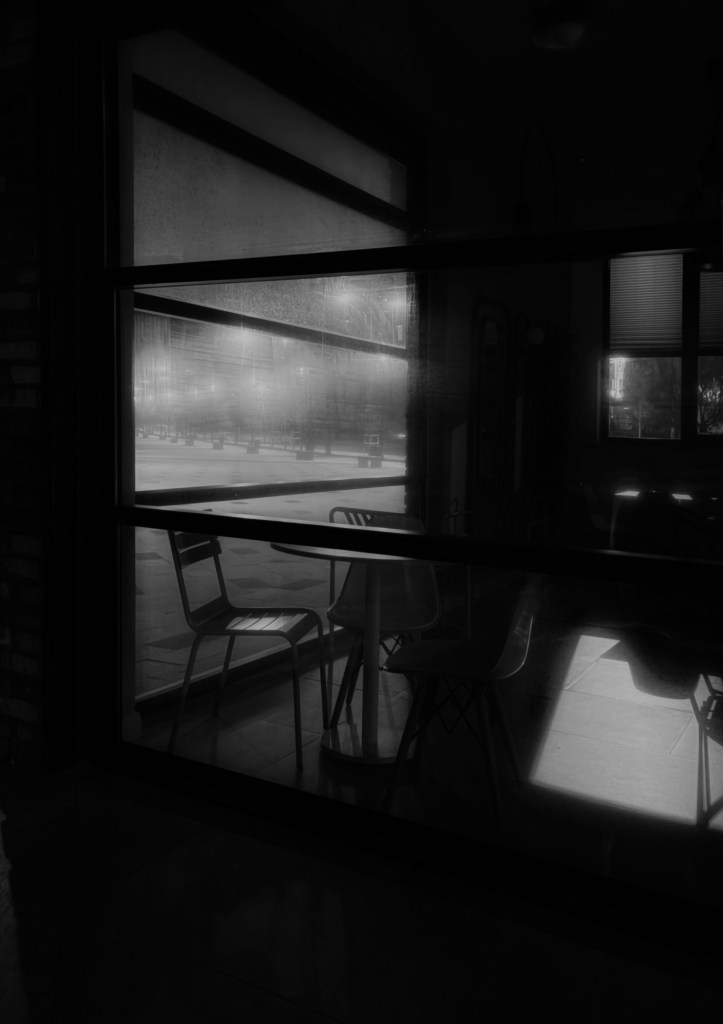
    It is close to midnight, and I am tired and cold. The playlist you curated for your book reading has given way to live music, and the crowd is slowly beginning to unwind. You watch me from across the cafe, while a young woman, about my age, talks to you.

    She takes off her coat and drapes it over her forearm. Her corset top is your favorite color on me—a muted pink—and her hair is styled as mine is. She shifts her weight from one leg to the other, adjusting her pleated mini skirt, but your eyes follow me as I walk toward the bar and order a glass of water.

    She is more beautiful than me, two inches shorter, so that even in her heels, she still has to look up to you. She has all of the adjustments you said you would make to my body when I pressed you to tell me which parts of me you would rework. And I know you see all of her, though your eyes insist on accompanying me.

    She cradles three signed copies of your book as she speaks. Her hand touches your arm and your eyes excuse themselves, and return to her. I turn to the bartender and smile. He walks toward me, and I almost order a bourbon, but I resist. I promised you—and myself—I would stop drinking. Instead, I ask for two glasses of ginger ale with ice.

    When I turn back to you, hoping to catch your gaze, or to see you walking over to me, I see her hiding perfect teeth behind her one-week-old manicured nails. Her entire body is laughing at something you have said. You are laughing too, but only with your face.

    I pick up my glass of ginger ale, and after three gulps, I set it down beside yours. Droplets of condensation have gathered around the glass, clustering like the books that line the shelves of the café. I rise and walk over to you, the second glass in hand. Before I reach you, you see me, and your entire body turns toward me.

    You take the glass from me, wrap your palm around my head, and my hair spills through the gaps between your fingers like a waterfall. It stings a little, but I do not mind. Then you pull me into you for a hug, and the patchouli from the scent I begged you to wear earlier this evening fills my nose. I close my eyes, open them again, take a slow, deep breath, then you rub my head and pull me upright.

    I ask if she wants anything to drink but she declines with a smile that does not reach her eyes.

    I return to an empty corner of the café, and settle into the distraction of the live band’s cover of Miles Davis’s  So What. The music swirls around me, filling the space with the familiarity of your living room. I take out my phone and scroll through it, checking to see if my mother has called since she left the hospital with my lǎolao. 

    She is laughing again. I do not know how much longer she will continue her performance, but I wait for your eyes to tell me when to head to the car.

    The inside of my mother’s Mercedes is cold, dark, and unpleasant to my skin—like her heart. I do not need to hang a photo on my bedroom wall to remember its details because I cannot escape it. Nonetheless, when I go to see you, I bring my mother’s Mercedes with me, because it reminds you of home. 

    I am careful not to break her precious things.

    You are a beautiful man, my mother tells me—like my father. That I am better off with a faceless man. 

    The inside of my father’s old G-Wagon is agave green. A photo of it hangs on my wall. In the photo, I am seven, sitting next to my father on the hood of the car. A naïve smile exposes my milk teeth. He is standing, smoking a cigarette, and he is beautiful, just as I remember him.

    When I am with you, you drive my mother’s Mercedes—your left hand on top. The high peaks of your knuckles cast shadows on the deep valleys between them. Your veins push against your skin. The dial on your wristwatch is agave green, like my father’s G-Wagon. You rest your idle hand on my thigh.

    My heart is safe until his calls barge in, and a silence the size of my father crashes into us. I want to switch off my phone, but you insist I leave it on for my mother’s calls. You are nothing like him, nothing like the men my mother insists on. With you, I pray never to disappoint, as I do with my mother.

    You do not drive like him—cautiously, uncertainly, afraid to take up space, afraid to abandon it. I tell you about him, his unwillingness to let go. I tell you he is still in love with me, and you tell me his love is too little for me. I tell you he never ran when things were difficult, and you tell me he had nowhere to run to.

    We approach a crossroad. The traffic light above us is red. It is the middle of the night, and my mother thinks I am home already. You do not like it when I tell lies, so you insist I let her know I am with you. 

    I pretend to send her a message.

    I am not worried about staying out longer than I should. She is with her mother tonight. Grandmother had insisted she visit her at the nursing home. My mother is burdened by duties. She resents her mother, and my father for leaving her. Once, she told me she did not love my father—that she only married him for his good family. I understand now that this helps her manage her loneliness. As I have always understood that I belonged to her, as she belongs to her mother.

    The light turns green, and we continue toward your place. Outside, on the road, I notice a harmless dust devil, spiraling on the roadside like a small tornado, swirling sand and dry leaves in a free dance, disappearing into the abyss of the night sky.

    There are words hanging loosely on your lower lip. You ask why I am still with him—why I keep him around. You do not understand how I could accept the affections of a man with a face as difficult as his. And if you do, you refuse to accept it.

    You blame him for my heartache but say little about my mother. You want to save me from him, but I am afraid of what you will find when he is not there to hide everything you will hate when you get too close. You tell me I love ugly men. It disappoints you. I hate myself when you feel that way.

    He calls again. 

    I want to turn my phone off, but you squeeze my thigh, and I stop. Thirty slow seconds come and go because he is too shameless to end a call early. 

    Once more, his call comes in.

    This time, you want me to pick up. I refuse. You park the car on the side of the road, take a moment to study my face, then ask why he calls me as if there is still an understanding between us—why I am afraid of what he would say.

    You can hear him. He wants a photo of me. He wants to know why I have not called back since he tried to reach me two nights ago. You do not want me to tell lies. I told you I had not spoken to him in weeks.

    I tell him we both need to move on. 

    He tells me he does not understand why I am saying that. 

    I have to go. I tell him

    Why do you have to go? He retorts.

    Because I have to. 

    Are you with someone now? I say nothing. 

    Are you with someone? I’m just trying to protect you. I remain quiet.

    You take my phone from me and switch it off. You do not say another word. Your hand on my skin feels like razor blades. And your eyes are unbearable.

    When we get to your place, you park my mother’s Mercedes in the lot, and we take the elevator up. You make me type in your passcode, and we walk into your loft. You take my jacket and put it away. You make me sit, take off my shoes, and rub my feet. You kiss them, one at a time, gently, and our ritual begins.

    Your eyes tell me I am beautiful. You want to undress me, to run your fingers down my skin, but I wish to remain clothed, sober. I am afraid of fading into you. But your gaze bends my will, and I let you do with me as you please.

    You begin from the bottom, then move to the top. You turn me around, and press a kiss to the arch of my back. My eyes fix on a portrait of you on your wall. You are a little boy, bare-chested. You are alone, save for a toy airplane in your hand.

    You spin me back, firmly, and I lose my footing. Your hands caress my skin, and I bleed. I am beautiful, I remind myself, in your voice. I am red all over, but I am beautiful.

    You come into me, slowly, hesitating. Then you take yourself back. I pull you closer. Your hand reaches for my neck and tightens its grip. The other crashes against my face, like a car wreck, and tears escape my eyes. I do not want you to stop.

    My face tightens and turns numb. I can barely breathe. I feel you grow and pulse inside me, and slowly, I fade into you.

    When I wake up, you are lying next to me—asleep, naked, like a granite sculpture. You are thirty. I am twenty-five. I am with you, and you are beautiful.

    In the shower, I think of him—his reckless calls. Water and blood run down my body, spiraling into the round hole in the shower, like a swelling tornado. One after the other, in a reluctant queue, I feel myself letting go of him.

    I step forward and close my eyes. Water falls on my face, soothing the ache where your hand crashed into me. I feel you washing away too. I reach for you, but then I feel him trying to grab hold of my hand, and I shake him off. You too.

    I reach again, for you. And I feel his grip. You are too close to him, and he is too close to you. I reach for your clenched fist, but your knuckles dig into my palm. I shift my weight from one leg to the other, doing my best to shake him off. But he holds on.

    I try again, and again. But every time I reach for you, he grabs my hand. Exhausted, hopeless, my palms aching, I beg you to fight him off, to reach for me. But your fist remains clenched, like a rock.

    I let go.

    I wait for a while, for a miracle, for you to come back to me. But I hear my mother’s voice behind me and I spin around. I see her face, wrinkled with disappointment, looking at me. I reach for her, fragile and expectant, but she vanishes behind the bathroom mist, beyond the glass door. And my eyes catch an unpleasant rendering of my face.

    I turn off the running water, open the shower door, and cold air rushes in from your living room. I look for your towel, but I do not see it.

    I am naked, I am alone.

  • Give This To April Mayfair

    March 1st, 2025

    My dearest April, I wondered why you went away. 

    And now that you are back, I cannot help but wonder why you let him handle you with such careless hands?

    It is early on a Sunday morning here in Beijing—03:55. I am thinking of going to church when the sun rises in a few hours, but sleep has abandoned me to my thoughts. I still need to pack for London, and I am not sure I have it in me to make the fifty-minute drive to church without rest. I have not been to service since winter, and the guilt is killing me.

    Late February in Beijing is much warmer than I remember, and I keep running into the sun before I am able to find a little sleep. I had planned to spend more time outdoors, to visit my god-sister whose IVF fell through. My mother insisted I see her before she left for London, but I could not step away from my computer. My doctoral thesis is due for blind review, and completing the latest draft took everything in me.

    I keep reminding God, during my morning devotions, that my parents—whom He loves dearly—would be very glad if their son came home with proof of the last six years spent in school. So far, all has gone well.

    It has been a week now since you called me with a troubled heart. I was in the midst of settling my engagements before my flight and could not find the time to call you back as I said I would. And since I am unable to sleep, I decided to write to you before I leave on Monday.

    Also, it has been more than a year since I last saw you in London, after we flew back from St. George’s together. Yet the details of you and your family that held my attention at the resort remain as clear as the Caribbean Sea.

    I remember your face. Your two sisters, too. And your mother and father. I remember the smile that never quite leaves your mother’s face—a safe kind of smile. The same one that sculpts the edges of my mother’s. I remember you reading under the sun in your swimwear, and eating alone at the restaurant before your sisters joined. 

    It is always striking how small a family suddenly becomes when a few members decide to skip a gathering.

    I remember wishing you all to myself, I remember the photos we took at the beach. And the water that was determined to swallow you whole as I clicked away with my camera. It is damaged now—the Canon I photographed you with. The rolls of film too. I look at photos of you on my phone now as I write to you about the men who you wish would color the grays inside you. Your mother’s smile returns to me, and once more, I find myself wondering how and when you turned sad. 

    ***

    I thought I would be done by now, but I could not finish writing to you last Sunday morning. My sleepless nights had finally caught up with me, and a heavy slumber took hold of my eyelids until the rest of my body succumbed.

    I spent the last few days and nights rewriting the first few chapters of a novel I wrote while applying to writing programs in the States. I am intent on showing my father how serious I am about writing—about clearing tall grass, tilling hard soil, and rising above the natural order of tradition and family he insists upon

    I am on the plane now, on my way to London. The young man next to me is reading an old copy of Anna Karenina. Earlier, before I continued my letter to you, he mentioned he was traveling to Berlin to see his wife. He is twenty-five. An Engineer at Audi. 

    They met and began dating during his exchange year in Berlin. They are expecting a baby soon, and he wanted to know what I thought about him moving to Germany to be closer to her. Her family insisted his wife remain with them until their child is old enough for school.

    ***

    April, I have been hurt before—by a woman I paid too much attention to. And she cried while doing it. Since then, I have refused to give another the pleasure. I have given the women in my life only enough to sustain my lust. 

    And so, I must tell you how extraordinary it is that, for the first time in your life, you are willing to speak out against who you are—to look at who you have become and seek change.

    I have found that happiness does not dwell behind my gate of brass, nor is there joy in living as I have lived. Real joy—the kind that holds meaning and retains its volume—requires that I comb the earth for the scattered pieces of my sundered heart and tenderly glue them back together. To accept that every beat will cause it to expand and contract, to bleed a little, to hurt a little. 

    But I have been too afraid.

    The man you speak of, Mr. Ezekiel Armstrong—the racing driver who left you in October for another woman—is no stranger to women who find little shame in giving men all that they are. But I cannot hold him ransom for the neglectful ways he has treated you when I, too, have been guilty of entertaining the attention of a woman who entered my life ready to serve my every need.

    I have wondered what makes a woman beg the way she did. 

    I told myself she was adult enough to understand the truth of her choices, that she was content with a fraction of my attention. But I knew these were lies. And yet, those lies were emboldened by the intoxicating feeling of having her as property, by her many pleas to hold on to the hem of my clothes.

    The truth I abandoned is this: she did not desire less from me because she was happy with little; she did so because all I was willing to afford her was little, even after she had given all of herself to me.

    But where should you direct your pointed fingers—

    at me, who was willing to give her less than what my friends had access to, or at her, who insisted she was enough for both of us? Should I have taken only as much as I was willing to give in return?

    Which one of us should be crucified for our sins?

    I will return to this at the end.

    The loneliness you feel cannot be erased by simply pouring paint over them and brushing until they disappear. Give it a little time, and they will reemerge. To better handle your loneliness, you must understand its very nature—where it resides, your encounters with it, and all the choices you have made that have alienated you from yourself.

    A young woman, Halimah, wrote to me some time ago. In her letter, she spoke of a young man whose actions failed to reconcile with the affectionate words he repeatedly threw at her. I wrote back, telling her:

    “The young man you speak of, the one you wish to forget, may not be forgettable. We do not get over a person by simply wishing for it, just as a lie does not become the truth because ten people are willing to tell it. So tell yourself the truth, repeat it over and over again, and fill your room with it until there is no space for lies.

    Tell yourself that you want him, but he does not belong with you. Tell yourself that you want him, but he is not right for you—that you are not right for him. It is a large room, so do not stop yet. Tell yourself that he is here to stay, and that it is all right that you must now shelter him.”

    Loneliness is the corner of the room. It lingers out of sight—hidden, quiet, ever-present. Sit with it. Trace its edges. Measure its depth. 

    It is your place of reflection and safety; it is where who you are retreats when she has been neglected. It is where you go to isolate yourself, your root—where you will end, where you began. 

    It is, also, where your truth goes to hide.

    The race driver—the one who abandoned you last October—like the man Halimah harbors feelings for, may never be forgettable. You will not forget him by simply employing your heart to feel again for another man, no matter how lovely the man may be.

    Men do not replace men.

    You will also not heal from your wounds by simply pouring spirits on them, because spirits do not heal wounds. They drown you, they turn you into a ghost, and leave you with a ghastly hollowness.

    For when there is little to be proud of about yourself, when you feel small, it is natural to want to attach yourself to a man who has conquered the world. But if he accepts you, he will demand that you only disturb your heart with what is important to him.

    You listen to him.

    You want him to be happy. 

    You want him to be happy with you. 

    It is January,

    and quietly, the deathly hollows spread inside you. 

    He consumes and affirms you all at once. 

    Each bite he takes from you, he tells you that you are still whole—

    and you believe him.

    But January has come to an end,

    and the February cold in Nottingham brings with it too much snowfall.

    Races are suspended, 

    long enough for him to devour what is left of you, 

    and you succumb to the hollowness.

    “You’ve been nice,” he says.

    He pauses to acknowledge your begging words.

    “I don’t understand, please don’t do this…” 

    You are unable to put together a compelling argument.

    “I need a little time,” he continues. “I’m sorry.”
    You’re sorry too. But you do not know what for.

    Except for not being enough.

    The call drops,

    and you condemn yourself to a smile.

    You have to.

    Your tears will break your mother’s heart.

    And you want to show him that you are strong—

    he likes it when you are strong.

    Perhaps, in a few months, he will find his way back to you.

    For now, you plan to keep up with his races.

    The first few months come and go.

    Work has been exhausting, and you miss a few rallies.

    But that is okay, you tell yourself.

    He will be in town this weekend.

    You will pick things up where you left them.

    Then, on a busy Thursday, the news finds you:

    He is with someone else now.

    You search your phone for his number and you find it.

    The last thing he said to you comes back:

    “Ape, you’re being pathetic.”

    You put your phone down.

    You pick it up again.

    You find her.

    The new girl is…but you do not finish the thought.

    You wrestle it back to a corner of your mind.

    You want to replace him with someone else,

    But men do not replace men.

    You cannot stitch the wounds from one man with the love of another—nor paint over your wear and tear with a fresh coat.

    The silence of Saturday morning in your bedroom is gently interrupted by the metallic scrape of your father’s shovel meeting stone. You wash your face in the bathroom, moisturize, and bundle yourself in layers of wool and a down jacket before joining him outside. He hands you the shovel, and you pick up where he left off, slowly clearing what remains of the snow.

    He returns with two hot cups of Rooibos tea, handing you one, then grabs a bag of salt from the garage and scatters it over the sidewalk. A short while later, your mother joins, followed by your two sisters. The weight of your mother’s palm on your back settles you. You raise your head and meet her gaze as she walks by toward your father. She smiles, and you smile back.

    Your sisters begin throwing snowballs at each other. One catches your right shoulder. You look up to scold them, but another strikes your chest. You toss the shovel aside, roll a snowball, and start firing back at the two of them. They shriek and they run off. 

    Their laughter rises into the morning air and falls back, soothing you.

    They dash past the magnolia tree in your compound and out through the black, wrought-iron gate. You notice the hint of pink in the swelling buds of the magnolia tree. 

    You walk over for a closer inspection, and take a deep breath—it is early spring, and these are the last days of snow. 

    Your father will be leaving again for work in a week, you think to yourself, and your mother will have to hold everything together until next winter. 

    You glance around for the cup of tea your father handed you. It rests on the hood of your mother’s Audi. You pick it up and head inside to warm it but decide instead to return to your room for a late morning nap. 

    As you drift off, your mother’s joy, your sisters’ quarrels, and your father’s busy hands rush through your bedroom window and fill your ears.

    ***

    She is gone now—the young woman who offered herself to me on a platter. I took her on a quiet walk somewhere beyond the premises of my life and left her alone there. In the end, I suppose we are all sinners—a mix of good people who do horrid things and bad people who have some good in them.

    I would like to think I am the former, though she might say otherwise.

    I am sorry about Ezekiel. He was never yours.

    True connection—the kind that you need—will be mundane, like a Saturday morning at home with family. Its warmth is incomparable.

    The plane has begun its descent, and the flight crew are making their final rounds. The young father-to-be sitting next to me is now sleeping.

    Regarding the question he asked me earlier, I told him it is important that he stays close to his wife and child. I also said that the quality of the time he spends with them matters more than anything else. The decision of where they should live, I added, should be made between the two of them—that while her family may mean well, their position does not take him seriously enough.

    He agreed with me, but said he does not want to come between his wife and her family. If his mother were still alive, he said, he would have someone on his side to look after his wife. I wonder if he has considered that perhaps his wife is capable of managing on her own without her family, or if he is simply frightened by the responsibility of moving them to Beijing. Perhaps she has remained silent on the matter because she senses his hesitation.

    In the end, he concluded that Berlin was where he met her, where they had fallen in love, and that the city holds, in its cusps, the version of themselves he believes is—in his words—essential to the survival of their union.

    I remain undecided on where I stand regarding his view of the fragility of the bond holding his marriage together. But I understand why he has, perhaps unintentionally, sided with his in-laws. Becoming a wife, a mother, and a new resident in a foreign country can bend even the most willing hearts and strain even the strongest bonds.

    I have to put away my things now. I will be in London for a month before traveling down to Enugu to see my parents. Come see me on Sunday, March 9th, if you can. I will be visiting my god sister in the middle of the week and should be done with my medical appointments by then. We could go to church together if you come out early enough.

    Here is the address where I am staying on Addison Road:
    *7 Addison Rd, London W14 8EB, UK.

    May the spring wind continue to blow your way,

    With love, from Seat 27A, British Airways

    Uchenna Onyishi.

  • Stay With Me, A Response

    October 1st, 2024

    Stay With Me ends like death; and though what was presumed dead had risen, I cannot help but continue to mourn. Because when something dies and comes back to life, it brings with it the stench of death. I wish Akin and Yejide, husband and wife, had shared the same hug she gave their daughter, Rotimi. Akin deserved it—or needed it. He had not only protected Yejide’s memory after she abandoned her family at the news of their daughter’s illness, but he had also nurtured, in their daughter, a love for her while she ran from the grim reality of losing a fourth child. This ending left me with an ache, not for the loss of love but for the absence of closure, a quiet despair that haunts both the characters and the reader.

    Reading Stay With Me during a period of personal transition magnified its emotional resonance. The world, as I knew it, was coming to an isolating end. I had just left my parents’ home in Enugu for my sister’s place in Abuja, to begin the process of returning to China, carrying with me a mustard seed of hope I had dug up from my mother’s overgrown garden. A year earlier, I had given up on myself. It was with this fragile hope that I read Adébáyọ̀’s novel, and I was left reeling at Yejide’s apparent ingratitude toward Akin at the book’s conclusion, when she was reunited with her presumed-dead daughter, Rotimi (a Yoruba name with a meaning that ties back to the book’s title). Despite all that had happened—the lies, betrayals, and deaths—I imagined, for the characters, a necessary reconciliation, an immaculate conception, free of sin, that I now understand I needed more than they did.

    Yejide’s refusal to acknowledge Akin’s sacrifices, his care for their daughter, and his efforts to preserve her memory raises critical questions. Can her choice be seen as a necessary assertion of her agency, or does it leave the story emotionally incomplete? And does Adébáyọ̀’s decision to withhold resolution strengthen the novel’s themes of loss and the enduring scars of betrayal in love, or does it deprive readers of the closure they—like Akin—need?

    At the end of the book, when Yejide finally makes it to the funeral of Akin’s father, thanks to the invitation she received from him, at their daughter’s request, she makes a poignant observation: Yejide observed that Akin’s hope had endured. In the face of her disappearance, he had bought himself grace by raising a daughter he could present to her as currency for his redemption. Nonetheless, Yejide understood this performance better than anyone else. She had been complicit in the illusions that had sustained their marriage and, therefore, was aware that while Akin had genuinely intended to raise their daughter well, he had also been keenly aware of the value of his well-performed fatherhood. His hope had endured, but so had his desire to control the perception of things that were most proximate to him.

    Adébáyọ̀ masterfully weaves these observations into the story through the alternating first-person narratives of Yejide and Akin in the final chapters. This allows the reader to closely spectate as the heightening suspense and hopefulness of their reunion cools into a measured detachment when the moment of confrontation finally arrives.

    “Under the canopies, everything is yellow and green. Green tablecloths, yellow satin covers with green bows for the chairs. I sit down on the first seat I can find under the canopy that has your name on it; there are over a thousand guests here. You must have spent a lot of money, but it is not showing as well as it should. Everyone at this table is complaining, no one has been served anything. Not even a bottle of water.” (Stay With Me, Adébáyọ̀ 294)

    In this scene, Adébáyọ̀ subtly invites the reader to participate in the decision that Yejide ultimately faces. A funeral does not demand a thousand guests. Such a gathering does not honor the departed, instead, it exists to allow the thousand to behold the thousand.

    This simple line—“not even a bottle of water”—ends Yejide’s observation with quiet yet cutting clarity. Water, a simple and universal gesture of hospitality, is absent despite the grand display. It is a powerful metaphor for the trust Akin denied her from the very beginning of their relationship by withholding the truth about his infertility. The absence of water becomes emblematic of Akin’s inability to provide what was most essential: honesty and trust.

    Stay With Me is a tragic narrative of love that is tested by cultural pressures, personal flaws, and devastating loss. In its world, children are not the only ones powerless in the face of death. In Akin, a selfish hope endures; in Yejide, resilience the size of a mustard seed germinates. Yet the same cannot be said for their marriage. It is difficult for a marriage to survive infidelity between a wife and her husband’s brother—impossible when that infidelity was orchestrated by the husband himself, in a desperate attempt to salvage his dignity.

    The ending rejects an easy resolution. Yejide’s embrace of Rotimi is a moment of redemption, but it is a redemption that excludes Akin. This exclusion feels unjust, yet it is this very absence that lends the conclusion its depth. Adébáyọ̀ does not offer closure but rather an honest portrayal of the fractures that remain even after healing begins. We carry the scent of death with us, even as we find ways to live again. 

    Adébáyọ̀’s novel leaves us in a state of mourning—not just for what is lost but for what might have been. Yet, this mourning is not despair; it is a quiet, enduring hope that even in brokenness, meaning can be found within ourselves, with closed eyes.

  • A Lesser Happiness

    September 1st, 2024

    I understand, you know, what it must feel like to love a man who insists that he loves you, too, but would rather be alone. The desire to convince him that life is better when it is shared. I understand that too. I do not disagree with you. 

    I believe you will love me until the day you die, and that gladdens my heart, and breaks it, too. 

    You will die. I know it. You will leave me before I leave you. The men in my family, they live a long life, they fall carelessly, they break easily, and they spend the elder half of their lives mourning their women, long before they are taken away by the plague. You too will die and leave me to the suffocating mass of your absence.

    I have to be alone now, to prepare myself for tomorrow. I would rather watch your happiness from afar, with this man that tells you that I do not love you. He thinks he understands love. He does not.

    The men in his family do not live long enough to watch their women die. Their lives are short and full of force as is their understanding of love. He did not grow up with lonely men. He did not suffer, in his childhood, the gashing wound of a father broken by the loss of the only person that knew how to love him.

    He looks at your full breasts and he is pleased that you are carrying his many children. He does not care that they will eat you from the inside, that they will tear you open, that they will bite and suck you dry, until your chest collapses.

    He does not see what his desires will do to you. He thinks they are natural. That they make him human. He holds onto them, and onto you, knowing well enough that you are without a heart for him. He refuses to let go because he thinks it makes him strong. But he is weak in spirit. Like his father, he measures love in effort. 

    You are a better woman without him.

    You must not settle for a life measured in sweat. There is no virtue in mindless commitments. We should live a life that is fully aware of the pain that is ahead of us. We must be wary of happiness. It will turn on us when we least expect it. And we must be wary of men and women who profess to us their love and devotion knowing that we do not have a heart for them. Men and women who are glad to break their bodies for us. We must be careful not to respect people who believe there is virtue in loving a heart that does not beat for them. 

    Nonetheless, I understand what it must feel like to love me when I have insisted that I would rather be alone. The desire to convince me that life is better when it is shared. I understand that too. I do not disagree with you. It is hard to lose someone who understands how to love you. 

    Much easier, someone you love.

  • Extremely Harmless & Incredibly Underwhelming

    August 1st, 2024

    Ugonna kisses me now. He tells me he loves the way I love him.

    I want him to tell me that he will not see the woman whose hair butter I still smell on his pillow again. That I was all he thought about when he was with her. And that he only indulged her because he thought I had given up on what he wanted us to have.

    I want him to know that I forgave him before he asked for it, even though he has yet to ask for it. I want to tell him all these things, but he is half-asleep now. So I pick myself up from his bed and carry my thoughts and my heavy chest into his bathroom. I hurry. I do not want him to see what mourning him, not knowing when he would come back to me, has done to my body.

    I slide into his rubber slippers. They are too big for me, but I do not mind. Everything about Ugonna has always been too big for me. He liked me that way. Overwhelmed.

    The water is cold now, so I let it run against the wall until I am engulfed by hot steam. I turn the faucet a little to the left and direct the water rushing out of the shower head into my palms, gently pouring it between my thighs until red water runs down my legs and gathers around my feet, coloring the white tiles beneath me. They do not stay there for long. I watch them as they run down the drain in a dizzying spin.

    I guide the steady beat of the lukewarm water across my face, letting it linger on my right cheek for a while. When I am done, I open his bathroom window to let out all the steam that has gathered on his walls and ceiling.

    He is fully asleep now. Harmless. Underwhelming. Just how I like him. I settle into his bed and gently wiggle my way into his arms. The evening sun is falling below the frame of his bedroom window. I wait for it to disappear. This time, yesterday, I was on my way here. There was no orange sun to commemorate meeting Ugonna again. Just a community of clouds loudly discussing the rain, while my eyes celebrated seeing the inside of his home for the first time since I ended things with him.

    The sun is gone now. Ugonna shifts his weight, and I do the same so I can breathe. I feel myself falling asleep so I close my eyes. I notice a butterfly hanging upside down by the window, her pale turquoise wings as still as an old widow’s home. I can tell she is not from around here. She stares at me, and I stare back. I wonder how she got in here. Ugonna never leaves his doors and windows open. I walk over to check on her, but each step I take feels like a step away, so I begin to run towards her. The faster I run, the further away I get. I stop running. I look around the room and see myself on the bed with Ugonna. The me on the bed looks like she is fighting for air. Ugonna’s arm is around my neck. I try to walk over to move his arm, but each step feels like a step away from myself. I try to run, but that only pulls me further away.

    A heavy fear wraps itself around me. I spin around in search of something to grab hold of and find myself standing next to the butterfly. Her wings flutter slightly. In a panic, heavy air forces its way into my lungs, and my lungs push back. I attempt two careful steps toward the glass window. I slide it open to let the butterfly out, and a sudden gust of wind blasts through, knocking me down. The butterfly too. She flaps her wings and circles the floor next to me in a seizure. I try to pick her up, but her wings turn to dust. I get up and shut the window. My chest swells and collapses even more as I struggle for air. I place my left palm on my chest and try to settle my heart so it does not get away from me. A severe pain takes a heavy jab at my chest and I fall back to the ground. I feel myself shutting down. A total darkness.

    Ugonna kisses me now. He tells me I have been out for a little more than a couple of hours. He asks if I am too tired to eat, but I am sore between my legs and do not want to make the trip to the kitchen. I ask him to pick me up and take me to the parlor.

    He places my risotto on the coffee table, turns off the air conditioner, picks up the TV remote, and settles into the sofa.

    “City is playing Tottenham today,” he says excited. “The guys will pick me up after the game.” I say nothing.

    “You want me to wake you up before leaving?” he asks.

    “If you feel like it,” I say.

    I want to tell him to stay with me, that I am afraid of what will happen if he leaves again, but this would irritate him. Instead, I wrap myself up in the blue knit blanket a friend got him for his birthday and let my head fall into his lap.

    I shut my eyes. Tightly, this time.

  • Give This To Halimah When You See Her

    July 1st, 2024

    My Gentle Halimah, I think about you. Here and there, at unexpected times in my day, I think about you. I imagine myself writing to you and watching as the words meant for you come together on their own. But I am unbelievably good at living many lives in my head. I have shown incredible love to women who have left me for other men, I have had several fathers who’ve died so I could live, and I have brought harm to the hearts of many women.

    I have become a great writer and a failed one, a father of a dead child and husband to a weeping mother. I have picked up the phone to terrible news about the most painful deaths, and I have watched women who loved me mourn my passing. All of these are part of the many lives I have lived in my head. So you can imagine how easy it is to have written to you several times without you ever witnessing any of it. Nonetheless, I am sorry it has taken me this long to write to you about the dry tears that stained your last letter.

    I did find the desk I went looking for. Writing and living many lives have taken a toll on my back, but I am receiving treatment for it. I was stubborn at first about getting a new desk—a standing desk. I always believed I only knew one way to write: at home, alone, at my desk, sitting, with soft jazz hovering, accompanied by the sound of rain, even on Beijing’s sunniest days. But I was wrong. Lately, I have been wrong about the many truths I once held close to my heart. 

    Recently, the woman I told my mother I would marry, told her mother she was getting married, but not to me. She told me this over the phone when she stopped by the supermarket to pick up a new set of light bulbs for her bedroom. The one she had, the one I helped her change the last time I was at her place in Asokoro, did not last very long.

    I suppose these things happen. Silly things like this happen, and all we can do is wrap our palms around our necks and force our faces, like clowns, to conjure a smile for their sake. Because we are supposed to wish them well, even if well does not share our company.

    The young man you speak of, the one you wish to forget, may not be forgettable. We do not get over a person by simply wishing for it, just as a lie does not become the truth because ten people are willing to tell it. So tell yourself the truth, repeat it over and over again, and fill your room with it until there is no space for lies. Tell yourself that you want him, but he does not belong with you. Tell yourself that you want him, but he is not right for you—that you are not right for him. It is a large room, so do not stop yet. Tell yourself that he is here to stay, and that it is all right that you must now shelter him.

    You have more than enough room inside you for all the men who will break your heart, all the men who will be gentle with you, and all the men whose hearts you will break—and the ones you will show grace. Fill your room with the truth until all the lies inside you that attach themselves to his words, the ones that want to believe the little acts of kindness that perch on your heart, wither and are carried away like dry leaves on a windy day. 

    His longing for you means nothing. I, too, would want a woman anytime, without knowing much about her. It takes very little to want a woman, much more to accept that I need her, and everything to understand what it means for her to need me, too.

    Take your time with all of it. Be afraid. Live with your fears. Understand what motivates them. Remember that your room is a large one, and you will have space to fall. Do not be in a hurry to forget him, for in doing so, you will forget yourself. He is a part of you now, as I am a part of you—and you, me.

    I am happy to hear that you are enjoying Mieko Kawakami’s Heaven and Osamu Dazai’s No Longer Human. They are wonderful books. I have yet to decide on my next read. I printed the first samples of my book a month ago. Still unsure what to call it. I do wonder how many people will be happy to read more than a few letters and short stories from me. I am afraid. The thoughts of failure are in love with me. My dear father made sure of it, without knowing he was doing so, in his many ways of showing me love.

    I still think about my love, another man’s wife, and the smile on my face, the wild drawn-out one, lingers. I am praying that hers’ is a comfortable marriage. I should get back to editing my book now. I wrote this while standing, before I could see the sun today. Though I hope you will read it in bed. I feel it settles better that way. I do not know how gentle you truly are. I only know that gentle words have a preferred residence.

    Take care of yourself. 

    Until I write again, Onyishi Uchenna

  • The Monster Under My Bed Looks Just Like You, 3

    April 1st, 2024

    A Wedding in Enugu

    Antonia, I am guilty of playing God. I do not know where to begin, or where to end. Would saying too little make it seem like I do not care. And how do I know to stop myself from saying more than I need to. Perhaps I should not concern myself with these thoughts. I would be feeding the very demon you chastise me of. But you must know that it is not perfection I am obsessed with. It is a clarity of mind. One that, like God, had forsaken me for many months.

    I have sat with myself, for weeks now, since receiving your letter, in an attempt to make sense of who I was during the last few months of our time together in Beijing. And I have sought reason and clarity for my actions towards you, despite a truth that I am quite certain never abandoned me. And so with little clarity on when to defend myself, and when to hold myself accountable, I am writing to you again, hoping not to succumb to the words whose midst I now find myself.

    I am sorry to hear about your mother. I would lose myself if any-thing happened to mine. And I would hate the world and curse God for afflicting such an unfairness on me.

    No child should experience a loss so deeply set before they are able to fully settle into the brutality of life. And your dad. How is he taking it? My father often tells my mother that it is her duty to bury him. I think I can understand that. I would not want to face my elderly years without the company of my favorite person in the entire world.

    I have so many questions I want to ask you. And I worry I will disturb your grieving heart. But it is best I carry on with them.

    You never really told me why you did it. And I do not know that you ever will. Why choose now to tell me that you are carrying our little girl, if you have decided to rid yourself of her? What is it you are playing at? It must have been convenient for you to assume that she would have destroyed the progress we had made at finding normalcy in our life before your father called you back home. It is difficult to believe that this was your reason for hiding her from me. 

    I have so many more questions I want to ask you. But before I do, it is important that I share with you the sorry details of how I came to learn about your affair with Bartholomew.

    But first, before I forget, I feel I should let you know that your father’s attentiveness towards you is not because he knows about the child you have done such a brilliant job of keeping from everyone in your life. It is because he worries about you. And beyond that, he needs your company now more than ever.

    Anyways, the affair. Barbara stopped by our apartment while you were in Shanghai with your Supervisor. And she asked if we could have dinner together. Bartholomew, she said, had left for Shanghai in a hurry the previous day. And she thought she could spend the evening with you and I.

    I told her you were in Shanghai as well.

    She came over the next morning to ask if I had any clothes that needed to be dry cleaned, and I handed her two of my blazers and the white linen shirt you bought me in Shanghai. I planned on dropping them off that afternoon. She came to see me later that evening to let me know my clothes would be ready the next day. And then she asked if she could join me for dinner and a few drinks at our place.

    A couple hours later, when I had gotten off the phone with you, after you informed me that your Supervisor wanted you in Shanghai for a few more days, she came over with some local meals she had prepared. And before settling down to eat, we stopped by the liquor store downstairs, to pick up a bottle of Caribbean Rum and some vitamin drinks for the night.

    Barbara asked a lot of questions. Mostly about you and your job. How often you were away. The last few times you had traveled. And when and where you traveled to. She wanted to know how I came to own my white kimono linen shirt with the hibiscus embroidery. And about your pink quilted sandals laying about in the living room.

    The night was coming along okay, until she picked up the phone to say good night to Bartholomew, and I heard So Long, Marianne in the background. I did not think much of it at first. Until the song that played right after. I am sure you know which one that is. And then all of Barbara’s questions came rushing back to me.

    This time, without all of the simple answers that hid an ugly truth.

    And I came undone.

    I do not recall when Barbara got off the phone with her husband, or how long she sat with me in silence, waiting for me to return to myself. But when I heard her come out of the toilet, as she walked back into the parlor to clean up the table, I thought about the rest of her conversation with Bartholomew, and then began sieving through all the details I knew would become our undoing.

    Barbara was washing the dishes when I joined her in the kitchen. She had not turned on the ceiling light, and I did not bother with it either. It seemed we were both content staying in the dimness for a while. Though the light above the staircase landing cast a soft glow into the kitchen that allowed us to carry on with the dishes.

    She took her time with each plate. So my thoughts had a while to fight the truth with the delusion that what I heard over the phone was a mere coincidence. I wondered why Barbara was there. Did she come over to learn more about the woman her husband had abandoned her for. And the man that had not done enough to keep his partner’s gaze at home. I rinsed each plate and gently arranged them on the dish rack. And for what felt like a while we carried on in silence.

    Barbara’s skin had become warm to the touch. Her arm had rubbed against mine each time she handed me a plate. I thought it was the rum. Then I thought… but Barbara, without turning to look at me, asked if she could spend the night. And when I asked why, she took a moment, but chose to continue with the dishes.

    When we were done, Barbara turned on the lights in the kitchen, and examined each of the plates in the dish rack carefully.

    Barbara and I sat in the parlor and talked about her new job attending to passengers on Hong Kong Airline’s short-haul flights. Three years had passed since she resigned from her job in Singapore to marry Bartholomew. And she had started looking into attending flights because she wanted to make sure she had no time to regret leaving her husband. She also said she had found an apartment close to the airport, but had delayed signing the lease because she was not sure about Bartholomew.

    She told me why she was leaving Bartholomew. She even asked if I planned on proposing to you; if you had been to my home town. I told her we had plans to visit the previous summer, but something came up at work. I did not bother with the details of whose work got in the way. I did not think it was necessary to tell her that. But I wonder now, how honest you were about that.

    I woke up the next day’s afternoon to a knock at the door. Barbara had called a moving company to help her move her things out earlier that morning. She had come to let me know she was leaving and to apologize for the rest of our night. She asked if I would be okay. And for a while we held each other in an embrace.

    A few minutes had passed when the truck driver called to let her know they were ready to leave. She asked if she could have something that belonged to me. Something I bought myself. And as she walked away from me, I thought about our night together. How we laid on the floor and talked about all the flights she was going to attend. And the tears that turned her eyes to a shiny glass when she talked about her widowed mom in Hong Kong.

    I held onto myself that night, so I could comfort Barbara. I owed her that much. She had been attentive enough to notice what remained hidden to me for so many months.

    I will stop here. Because the rest of it, you already know.

    Antonia, being cheated on, I learned very early in life, is a feeling that can only breathe one way. You can either let it go and not give it any chance to frame what is left of your relationship, or you can hold on to it and allow the dark clouds it comes with to hover above all that is precious to you. And when enough clouds gather in, they will invite a storm that will destroy everything in its path.

    And yet, knowing all of this, I held on.

    And the details of your betrayal, the sleepless nights, and the insatiable desire to understand why you chose such a violent way to tell me that you were too scared to take the next step in our relationship, had me as their object. And when they were done with me, a different madness had its way with me as well. One that came with a rope that pulled me down to an endless pit, tied a noose around my neck, and dared me to find my way out.

    And in that pit, God abandoned me. And the devil had his way with me. And no matter which way I tried to go, I felt the noose pulling at my neck. Nothing mattered anymore.

    I wanted you to feel what I was feeling. So I searched for ways to punish you for your iniquities. Because God, I was convinced, was too gracious to do it Himself.

    I did not search for long. You were like a Catholic in the middle of Lent, insisting on all manner of punishment. So as penance, you convinced me of your devotion by offering yourself as a tool for all of my pleasures. And without restraint, I indulged.

    The shame of the rage I acquainted your body with, your tears that aroused me, and my neglect for you during those months follows me still. I was lost, and lonely in my despair. I knew hurting you would not heal me. But I did not care.

    Healing was not an option for me.

    But then I met Barbara, and everything changed. I took one of her flights to Hong Kong. And later that night, we met at the bar in the hotel she and her aircrew were staying. We talked until dawn, and then she had to hurry back upstairs.

    She was doing a lot better. She talked a lot. More than she used to. I thought it was an act at first. But as she talked, it became difficult to deny the nowness of her spirit. She was present. She had let go of the past. Including the one that we shared. And when we said goodbye, she asked, again, if I would be okay. And with a desperate gentleness I told her I wanted to be.

    And for the first time, healing became an option.

    A few days later, on my flight back to Beijing, the tears finally came and filled the pit. And the current carried me with it until I found myself on hope’s shoreline.

    Now you know why everything changed after Hong Kong.

    Antonia, I hope that when the day comes that you choose to tell our story to strangers that take a seat in your new life, that you will tell them how well I loved you, before you tell them how much I hated you for becoming too familiar with our neighbor while his wife mourned the end of her marriage in our living room.

    I am guilty of many things. I will be the second to admit it. But hating you, is too ambitious a task, even for me. It is because I needed you, that I was so careless with you. And it is because I was sure I had lost you, that I was so willing to burn you down with a slow fire. 

    You were right. I became the devil. But even he loved you the only way he knew how to. 

    For my part in all of this, I am deeply sorry.

    My cousin Ifemefuna is married now. It was a small wedding in our compound. My mother was happy to confirm that a baby had nothing to do with the rushed marriage. Last week, Ifem and her husband, Ikenna, visited my parents to thank them for their help with the wedding. I asked her, when we were alone, why she wanted to get married so quickly. She said that she was tired of saying good bye to Ikenna every time she went to visit him in the parsonage where he lived.

    I wish you told me that Abuja was too much of a rush for you. Nonetheless, I know it has been over a month since you wrote to me, but I hope you kept the little one. It is dangerous to play God.

    Look after yourself. 

    Sincerely,

    Anthony Ibeanu.

  • The Monster Under My Bed Looks Just Like You, 2

    February 1st, 2024

    A Death in Maryland

    Anthony, do you not think it rather strange to write to me in such a manner if you do not wish to hear back from me again. And do you not know that ending your letter the way you did was disingenuous; or am I the only sinner here.

    My mother is alright now. She passed on the 3rd of January. On the same day your letter was dropped off at my place in Bethesda. In the end, she looked tired. Like she did not want to be here anymore.

    I miss her everyday.

    I was going to honor your request not to write back. But as weeks went by, and I read your letter more than a few times, I came to a settled conclusion that despite your words, you wanted me to write back. And even if you did not, I was going to. I needed to keep my mind away from everything that was going on in Maryland.

    It seems nothing about the way we left things has changed. You still think you are above wrongdoings because I have sheltered your thoughts; because those who love you have kept your sins away from you. And so you walk around with your barely wounded heart, and your ignorant mind that believes you are without sin.

    But you must know that the tragedy of your perfection is that it demands that everyone else bear your flaws. And I am too tired now to continue doing that.

    So here are a few burdens you can help yourself with.

    The child I am carrying is yours. But soon, that will not matter.

    And it only took you this long to put together the reasons why I left things the way I did because it had been a while since you abandoned your affections for me. Because despite lending me forgiveness in our darkest hours, you only stayed with me because you felt my wrongdoings had afforded you superior standing in the affairs of our lives. And I accepted it because I imagined you would see the wrong in your ways, and come back to yourself. But you never did. 

    I prayed for you. For God to heal the wounds I inflicted upon you so you could look at me the way you used to. But He did not answer me. I suppose He could not answer me. To do so would have meant getting through to you. But you were taken by the devil and his ways.

    You used my body when it pleased you. You tied me up and wrapped your palms around my neck until my eyes begged for my last breath to be let out, so you could be let in. And when you were finished with me, as your ropes came undone, I waited for your eyes to meet mine .

    Summer came and went, and slowly, Beijing’s roads were filled with yellow leaves. And then October came around, with its cold breeze. And my father called and told me the doctor said my mother would not make it through Christmas if she was not operated on.

    My father had tried his best to avoid anything that would require cutting open my mother’s skin. But that was the only way he could keep her around now. And so he let them slice my mother open.

    And when I told you about my mother, and you took my hands to say a prayer for her, I watched your face and listened to your words, and I wondered who you were praying to. How can a man that has refused to listen to God, talk so casually to Him. But you carried on praying. Because as long as my mother was just alright, I would not need to leave Beijing and you.

    And for some time after her surgery, she was okay. And so were we.

    Until the first snow of the winter. I still remember that day. It was the morning of December the thirteenth. It was not supposed to snow that morning. I know because I checked the weather before booking my supervisor’s flight the night before. But it snowed. And her flight to Shanghai was delayed until later that morning.

    When I woke up feeling a little ill that morning, like the previous mornings, I quietly made my way to the bathroom, opened the test kits I had bought on my way back from work a few nights before, and made sure to follow all the steps, three times.

    A little while later, I heard you get out of bed, and I ran out the door with very little clothes on so I could get rid off the test kits in the bin downstairs. And that was when I noticed it had been snowing.

    And for a moment, I debated going back upstairs to put on more clothes but I was not ready to announce that you were going to be a father. I was not sure how you would take it.

    But I did not want another lie to come between us again.

    I was going to tell you. I decided I would in the elevator. But when I got to the door and heard you on the phone with your mother, and that you were telling her how good things were in Beijing, a chilling fear settled on me.

    So I waited outside our door, until you went back upstairs.

    The neighbors that walked by were a bit confused, I tried to smile, to let them know everything was okay. The groceries I ordered the night before arrived. Some of your packages too. Mr. Williams said hello as he rushed off to school. But not before stopping to let me know his family in Maryland were coming to visit for Christmas when St. Paul’s High closed for the holidays.

    As I stood in the hallway, watching the snow through the window, I recalled going to China Japan Friendship Hospital with Martha a few years back, so I planned to go back that weekend. But I would later develop a cold that kept me in bed for a week. 

    I was scared you would find out. I imagined every possible way it would happen so I could be ready for it. And then, I recovered. Days before Christmas. And I got the call from my father that I needed to come back home. He would not say why. But I knew then that my mother was not going to make it. 

    And just like that, a fear greater than losing you barged into me. And so I began planning my trip back to Maryland. But I could not bring myself to telling you the truth. Because with you, I was always careful not to put too much on your plate. 

    You hated having too much on your plate. It made you sick.

    My mother hardly prayed for herself when she was in the hospital. Not even when the doctors said her health was improving, or when they said she was getting worse. She did not like to bother God with inevitables. So she focused her prayers on my well being. 

    My father said she did so because she loved me. But if you love someone, what good is your absence?

    I wish she knew about the baby. Maybe then I would have a reason to keep her around. I do feel my father knows. He has been very careful with me lately. Or perhaps it is because of my mom. Nonetheless, I am ashamed of how I spent the last few months of my mother’s precious life. And I do not want a child that will remind me of it.

    Anthony, I pray no one puts you through what you put me through. While my actions back then may have hurt you, it takes true hatred to burn someone down with a slow fire; to hurt them until that is all they know how to feel.

    Before my mother died, she held my hands in prayer, and asked God to deliver me from the evil that men do, and to send me someone who can be honest about the little love they can spare me.

    So far, I believe He has answered one of her prayers.

    Maybe it is not such a bad thing that your cousin Ifemefuna is with child. People are not just one thing. Perhaps it will do your mother some good to experience a little disappointment. Because it is pathetic to only love a person on their brightest days. 

    Antonia Anderson.

  • The Monster Under My Bed Looks Just Like You, 1

    January 1st, 2024

    A Winter in Beijing

    Antonia, I would ask about your ailing mother, but I do not think I want to hear from you after this.

    I thought I was going to die the other night. It has been three times now since you left that my lungs have forgotten to do anything with the air inside it, because my whole body was too busy trying to make sense of the reasons why you insisted everything we shared had to come to an unnecessary end on Christmas Eve.

    And then my mother called. And slowly, my chest settled, as she shared news about my cousins from my father’s side. 

    One of them, Ifeanyi, who is around my age, though a little younger, is getting married before February’s end. My father used to sponsor his undergraduate studies, but he dropped out of school a year ago to open a church inside the apartment building my father gave his mother, my father’s sister. 

    I am sure he has come up in our conversations.

    She also shared news about Ifeanyi’s sister, Ifemefuna. She too has decided to take some time away from school. Last week Sunday,  the assistant Pastor at their church came with her mother and Ifeanyi to see my father. Because the assistant pastor was interested in marrying Ifemefuna. My mother thinks she is pregnant. She thinks that is why they are hurrying everyone up. But my father disagrees. He said his sister and the assistant pastor have no reason to tell such unnecessary lies. That it is in her nature to rush things.

    It was then that the details of the weeks leading up to your hurried decision to leave us came to me. Like the changes to your body you said was because of your new diet, the tampons you stopped asking me to pick up at the store, and the unusually long showers you started taking in the mornings. And then I felt my chest begin to tighten again, and I held on to my mother’s voice.

    And just before my mother had to go, I asked her what she would do if she learned that Ifemefuna was indeed pregnant, but she could not hear me. The network had dropped for a moment. And I did not ask again. I knew what she would say. She would be disappointed. But in the end, she would be there for her. Because unlike my other cousins from my father’s side, my mother was always fond of Ifemefuna.

    Before hanging up, my mother said she loved me. That she wished I had come home for Christmas. She also said that my father could not come to the phone, but he misses me too. And that my tomatoes, the ones in her garden, had ripened, and she had made my favorite stew with them for Christmas.

    But she did not ask about you. Though, I wish she did.

    I wanted to tell her how you left in such a hurry. And that she was right about you and I. That I spent the last days before Christmas, and all of Christmas in bed trying to decide how I was going to keep you around, before booking a flight to D.C. to see you. But you insisted you did not want to see me again.

    I think I am okay now. At least I am trying to be.

    Christmas has come and gone, and the green on the Christmas trees are fading, along with the sting of our last words to each other, before you cut off all communication with me.

    The new year is quiet in Beijing. I thought I would like that. So I am writing to you now because I want to let you know that I am trying to forgive you. Even if you do not deserve it. That I think I know why you left us behind in such a hurry. And that you were right to do so without telling me. Because it would have broken me. And I would have done things to your body I know I would regret.

    Anyways, this is the last time you will hear from me. I hope you and the child I have concluded you are carrying are doing okay. Unless, of course, you chose yourself. If that is the case, then I pray you find peace with where your choices have brought you. I am trying to do the same.

    I have been struggling to keep my mind in this city. And though there are a few things in Beijing I could occupy myself with, I feel I should go home to Enugu. Ifemefuna’s wedding is coming up at the end of January. And it would be a great place to reconnect with my cousins from my father’s side of the family. 

    Do take care of your mother. I will miss you.

    Sincerely,

    Anthony Ibeanu.

  • A Headstone in Mama’s Garden

    November 1st, 2023

    I know the version of myself you think is good for you; the one that swore to put you above all that is good for him. He is dead now. He died this morning, or yesterday maybe. I am not sure. But I buried him in my mother’s garden, in the backyard of our family home in Enugu, next to the basils and the withered flowers of the tomatoes my mother planted sometime in October, after the rainy season.

    I woke up that morning to an unusually quiet mind. When I got out of bed to use the bathroom and take a hot shower that helped with the January cold wrapping itself around my chest, I saw him lying there. Lifeless. Fatally wounded by his failures to love you perfectly without asking too much of you.

    I stood there and watched him for a while, refusing to cry for a young man who was foolish enough to believe you when you told him your heart would come around. I refused to cry because I had seen what my tears could do to my mother. And I could hear her in the backyard calling my name. The garden had not been pruned in a while.

    Above us, the southern-eastern clouds were gathering for their first meeting of the new season.

1 2
Next Page→

Blog at WordPress.com.


Loading Comments...
 

    • Subscribe Subscribed
      • UCHENNA ONYISHI
      • Already have a WordPress.com account? Log in now.
      • UCHENNA ONYISHI
      • Subscribe Subscribed
      • Sign up
      • Log in
      • Report this content
      • View site in Reader
      • Manage subscriptions
      • Collapse this bar